AI Code Editor
Zed
A fast collaborative code editor with Zed Agent, ACP external agents, parallel threads, Zeta edit prediction, MCP context, and reviewable AI diffs.
- Pricing
- Free editor, paid AI usage may vary
- Platforms
- macOS, Linux, Windows
- Website
- https://zed.dev
My take
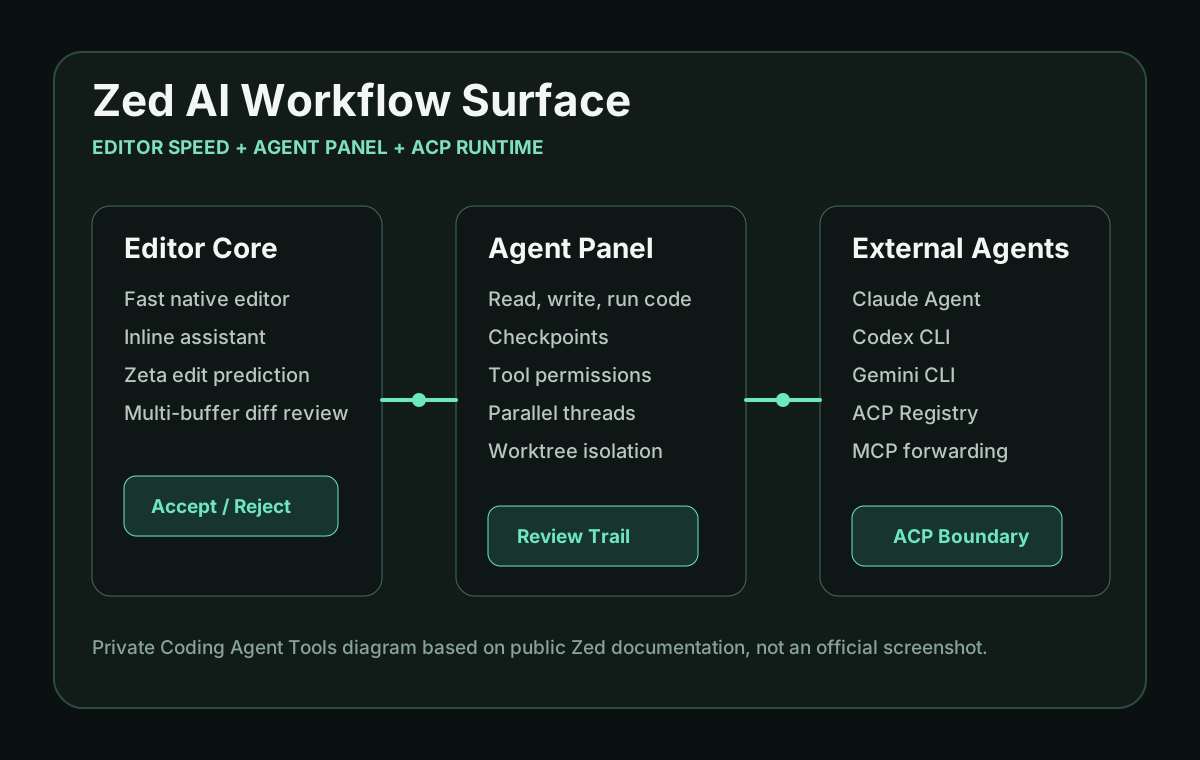
Zed should no longer be treated as a lightweight Cursor clone. In 2026 it is better understood as a fast native editor with a serious AI layer: Agent Panel, parallel agent threads, external agents through Agent Client Protocol (ACP), MCP context, Zeta edit prediction, checkpoints, tool permissions, and multi-buffer review.
My take: Zed is strongest when you care about editor feel first and want agents to live inside that editor without turning the product into a VS Code fork. It is weaker if your main job is long-running terminal delegation, cloud background work, or team governance at the level of Claude Code, Codex, or Antigravity.
What Changed Recently
The important change is that Zed’s AI story is now broader than “chat in an editor.” The official docs position the Agent Panel as the core AI editing surface where agents can read, write, and run code. Zed also now documents multiple agent threads, worktree isolation, terminal threads, checkpoints, reviewable diffs, tool permissions, rules, skills, MCP, and external agents.
The external-agent layer is the most strategic part. Zed supports Claude Agent, Codex CLI, Gemini CLI, GitHub Copilot, and additional agents through ACP. That means Zed can become a client surface for other coding agents instead of competing only as a first-party model wrapper.
Features Worth Tracking
- Agent Panel: the main surface for code generation, refactoring, debugging, documentation, and project Q&A.
- Parallel agents: multiple threads can run independently, and worktree isolation helps avoid two agents editing the same files.
- External agents via ACP: Claude Agent, Codex CLI, Gemini CLI, and other ACP-compatible agents can run inside Zed’s panel.
- Terminal threads: shell sessions and external agents can live in the same thread sidebar, which makes supervision less scattered.
- Checkpoints and review: Zed can surface edited files, line counts, multi-buffer diffs, and restore checkpoints for first-party agent edits.
- Zeta edit prediction: Zed’s built-in open-source edit prediction model handles keystroke-level suggestions, with support for other providers such as Copilot, Codestral, Mercury Coder, and local/self-hosted OpenAI-compatible endpoints.
- MCP and context servers: Zed can forward MCP context to some external agents while still respecting the agent’s native configuration boundary.
- Business controls: teams should inspect organization controls, privacy posture, and provider billing separately from the editor UX.
Where It Is Strongest
- Developers who want code reading, chat, edits, and terminal supervision in one fast native workspace.
- Teams that like Zed’s collaboration and editor performance, but still need access to Claude, Codex, Gemini, or Copilot-style agents.
- Workflows where review happens through visible editor diffs rather than opaque transcripts.
- Developers who want Zeta-style edit prediction without giving up the option to bring external model providers.
Where I Would Be Careful
- ACP integration does not make billing, privacy, or legal terms magically uniform. External agents still use their own provider accounts and policies.
- Some Agent Panel features may not apply to every external agent. Zed’s docs explicitly call out gaps such as history restore, checkpoints, token usage display, or message editing for some integrations.
- The editor can make generation feel smooth while still producing oversized changes. Review discipline still matters.
- If the core workflow is background cloud agents, PR automation, or long-running terminal jobs, Codex, Claude Code, opencode, Gemini CLI, or Antigravity may fit better.
Zed vs Cursor vs Claude Code
Zed competes with Cursor on editor feel. Cursor still has a stronger reputation as an AI-first daily IDE, but Zed’s counterargument is speed, native UX, collaboration, and a cleaner path for bringing external agents into the editor.
Zed competes with Claude Code and Codex differently. It is not mainly trying to beat them as terminal agents; it can host them through ACP or terminal threads. That makes Zed more interesting as a cockpit for agents than as a single-agent replacement.
How I Would Evaluate It
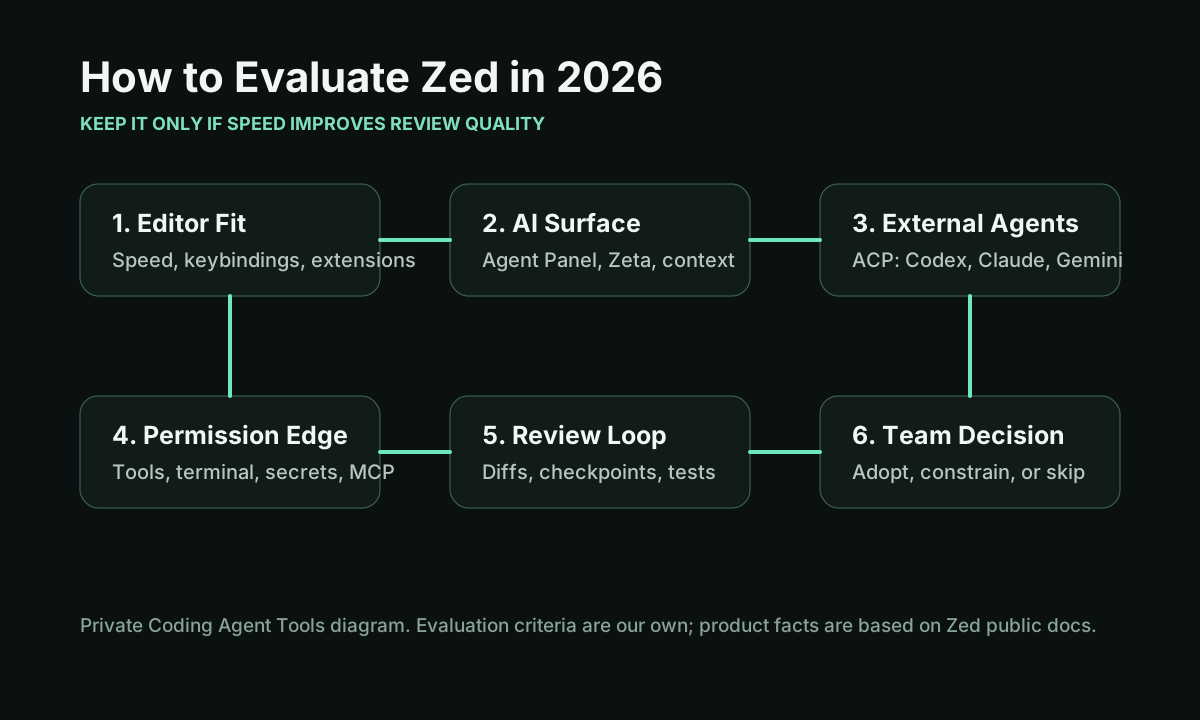
- Run one task with Zed Agent, one with Codex or Claude Agent inside Zed, and one in the native external tool.
- Compare accepted diff size, review time, test results, and how easy rollback is.
- Test Zeta edit prediction for daily flow separately from agentic multi-file changes.
- Decide whether ACP makes supervision clearer or merely adds another layer of configuration.
- Document which files, secrets, MCP servers, terminal commands, and production systems stay outside the agent boundary.
Related Tools
- Cursor and Windsurf for editor-first AI coding.
- Claude Code, OpenAI Codex, and Gemini CLI because Zed can work as a client surface for these agent styles.
- opencode and Aider if you prefer terminal-native or Git-centered control.
- Antigravity if you want Google’s agent-first IDE/CLI direction.
- 9Router and OpenRouter if provider routing and cost control are more important than editor UX.
Coding Agent Tools verdict
Zed’s 2026 value is not “another AI editor.” Its value is the combination of fast editing, reviewable diffs, Zeta predictions, and ACP-based agent hosting. I would rank it higher for developers who live in the editor all day and want controlled access to multiple agents. I would rank it lower for teams that need mature background task orchestration, strict procurement controls, or deep terminal automation.
Source Notes
- Zed official docs describe the Agent Panel as the core AI code editing surface for agents that can read, write, and run code.
- Zed docs describe multiple threads, terminal threads, worktree isolation, checkpoints, context mentions, review changes, tool permissions, rules, skills, MCP, and provider configuration.
- Zed external-agent docs describe ACP support for Claude Agent, Codex CLI, Gemini CLI, GitHub Copilot, and additional ACP-compatible agents, including billing/privacy boundaries for external providers.
- Zed edit prediction docs describe Zeta, free monthly Zeta prediction limits, Pro plan behavior, alternative providers, and local/self-hosted OpenAI-compatible edit prediction endpoints.
- This page uses private Coding Agent Tools diagrams based on public Zed documentation, not copied official screenshots.